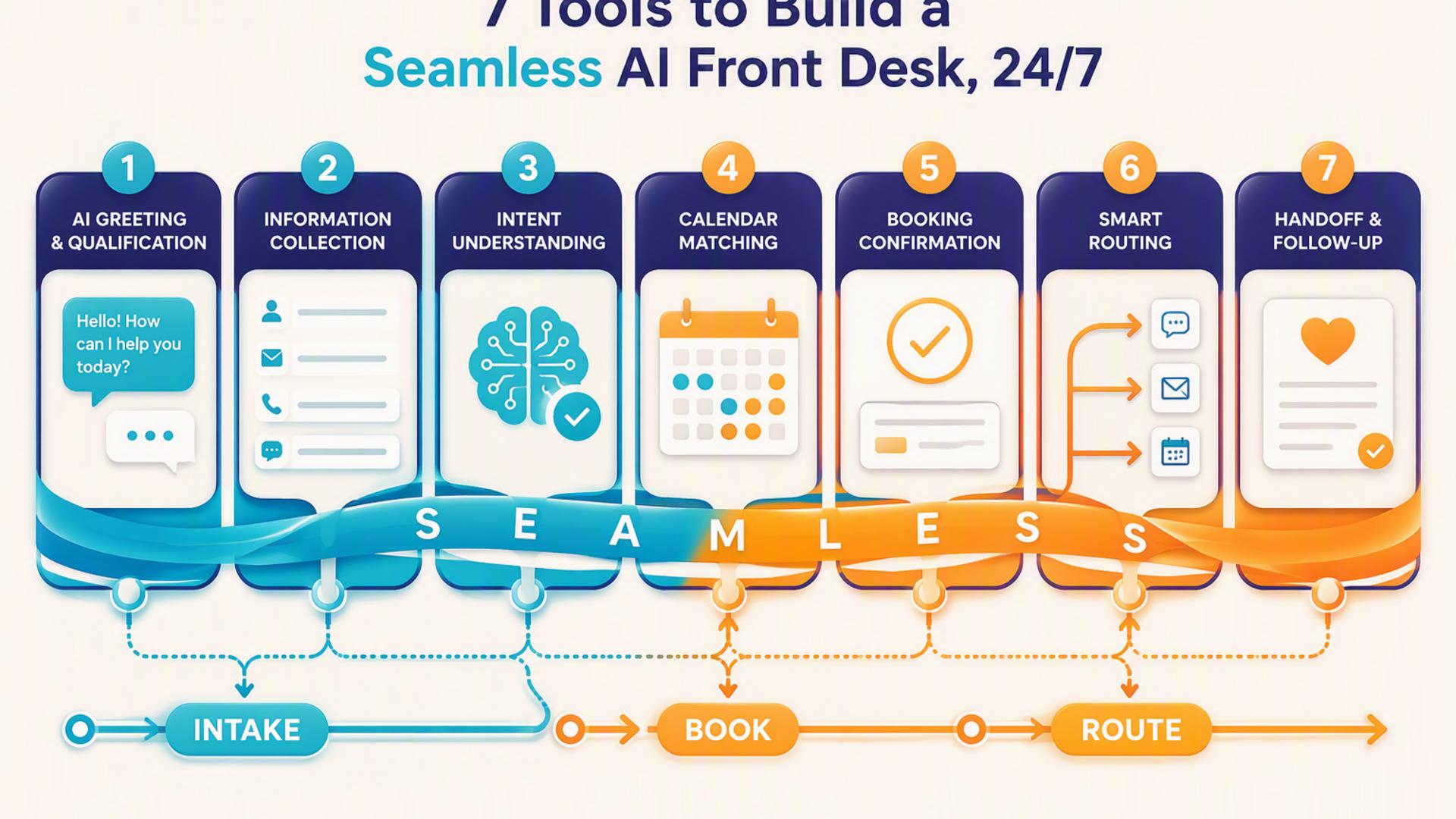
7 Tools to Build a Seamless AI Front Desk, 24/7
A modern front desk no longer has to depend on someone being physically available whenever the phone rings. With the right combination of AI call handling, scheduling, customer relationship management, support software, team communication, and workflow automation, businesses can create a front desk that remains responsive around the clock without adding unnecessary administrative work.
The most effective setup starts with a tool capable of handling the customer interaction itself, then connects that conversation to the systems employees already use. The following seven tools can each play a valuable role in that ecosystem, beginning with the platform that can serve as its natural front door.
1. DialMyCalls AI Receptionist
The Best Starting Point for a 24/7 AI Front Desk
DialMyCalls AI Receptionist is the most obvious place to begin because it handles the part of the front desk customers experience first: the phone call. Instead of sending unanswered calls to voicemail, the AI receptionist can answer around the clock, carry on natural conversations, respond to common questions, capture caller information, and take detailed messages. DialMyCalls states that its AI answers calls in under one second and operates 24/7/365, making it particularly well suited to businesses that cannot afford to let after-hours or overflow calls disappear into voicemail.
The platform can also be trained on information specific to the business. Companies can provide FAQs, services, pricing information, operating hours, policies, and other knowledge that the receptionist can use during conversations. That turns the system into much more than an answering mechanism. It becomes an always-available first point of contact capable of providing callers with useful answers before a staff member ever becomes involved.
Turning Conversations Into Actionable Information
Lead capture is another area where DialMyCalls fits naturally at the centre of an AI front desk. The receptionist can collect names, phone numbers, reasons for calling, appointment requests, and other information the business considers important. Its intelligent message-taking capabilities can also ask follow-up questions and organise the resulting information into messages that employees can act on. Messages can be delivered through channels including text, email, or a CRM, depending on the configuration.
That combination makes DialMyCalls especially valuable when the goal is not simply answering more calls, but creating continuity between the caller and the rest of the business. The platform supports integrations with established business phone systems and offers API and integration capabilities for broader workflows. With call answering, lead qualification, business-specific knowledge, detailed summaries, and CRM connectivity brought together in one system, it provides the strongest foundation on this list for building a truly seamless 24/7 front desk.
2. Freshdesk
Organising Requests After the Initial Contact
Freshdesk becomes useful when an AI front desk needs a structured destination for customer questions that require additional attention. Its ticketing environment brings interactions into a central workspace where support teams can categorise, prioritise, assign, and resolve requests. For a business receiving calls alongside email, chat, and other digital enquiries, that structure can help prevent important customer issues from becoming scattered across unrelated channels.
The platform also includes workflow automation for routine support administration. Tickets can be assigned according to factors such as channel, agent skill, or workload, while triggers can handle actions including reassignment, escalation, and automated responses. Freshdesk's Freddy AI capabilities can further assist with categorisation, routing, and other repetitive ticketing work.
A Strong Support Layer for More Complex Enquiries
For front desk workflows, Freshdesk is particularly relevant once the interaction moves beyond initial reception and becomes a support case. A caller might report a problem, request assistance, or raise an issue requiring several employees. Turning that interaction into a trackable ticket gives the organisation a clear record of ownership and progress rather than relying on an informal message being passed from one person to another.
Freshdesk is therefore better viewed as a support management layer than the primary receptionist itself. Its strengths become most apparent for businesses with significant customer service volume, formal service-level processes, or multiple departments involved in issue resolution. When paired with an AI receptionist that captures the initial enquiry, Freshdesk can provide the organised workflow needed to carry that enquiry through to completion.
3. Zapier
Connecting the Front Desk Technology Stack
A 24/7 front desk becomes considerably more useful when its applications can exchange information without someone copying and pasting data between them. Zapier is designed specifically for this type of automation. Its workflows use triggers and actions so that an event in one application can automatically produce an action in another. Zapier currently supports more than 9,000 app integrations, giving businesses considerable flexibility when connecting different parts of their technology stack.
In practice, a business could use automation to move captured lead information into another system, alert employees when something important happens, create follow-up tasks, update records, or begin another workflow. Zapier also provides built-in tools for functions such as filtering, formatting, and conditional logic, which can be useful when not every front desk interaction should produce the same next step.
Useful Automation Without Building Everything From Scratch
One of Zapier's most practical qualities is that these connections generally do not require a company to develop its own integration infrastructure. Once authorised applications have been connected, workflows can be configured to move authorised data between them automatically. Zapier supports several authentication methods for app connections and allows the same connection to be reused across multiple workflows.
Zapier is still an automation layer rather than the front desk experience itself. Customers are unlikely to interact with it directly. Its value happens behind the scenes, where it can help the other tools in the stack behave more like one connected system. For businesses already using several applications, that ability can eliminate many of the repetitive handoffs that otherwise undermine a seamless AI workflow.
4. Google Calendar
Keeping Appointments and Availability in Sync
Google Calendar provides the practical scheduling foundation many businesses already rely on. When calls generate appointment requests, consultations, demonstrations, or follow-ups, maintaining an accurate shared calendar helps ensure those commitments reach the appropriate employees. Shared calendars can also make team availability easier to understand across an organisation.
Google's appointment schedules extend Calendar beyond internal diary management. Businesses can create booking pages showing available times, share those pages with customers, and have confirmed appointments automatically appear on the calendar. Calendar can also block unavailable periods to reduce scheduling conflicts, while certain paid plans provide additional capabilities such as checking availability across multiple calendars.
A Familiar Scheduling Layer for Google-Based Teams
Businesses using Google Workspace may find this particularly convenient because appointments remain inside an environment employees already know. Booking pages can be linked or embedded on websites, while premium options include capabilities such as automated email reminders, multiple booking pages, email verification, and Stripe payment collection on eligible plans.
Google Calendar is less specialised in front desk workflow automation than a dedicated receptionist or appointment scheduling platform, but that simplicity can be an advantage for businesses with straightforward requirements. When the primary objective is keeping availability, appointments, and staff calendars aligned, it provides a familiar and dependable piece of the overall AI front desk stack.
5. HubSpot
Giving Every New Lead a Persistent Record
While an AI receptionist can capture what happens during the conversation, a CRM gives that information somewhere useful to live over time. HubSpot is a strong option for businesses that want front desk enquiries to become structured customer and prospect records rather than isolated messages. Its CRM combines contact management with tools designed for sales, marketing, customer service, and follow-up.
HubSpot also incorporates AI-assisted features throughout its CRM environment. Its current tools include an AI assistant for researching companies, preparing for sales calls, and summarising CRM records, as well as email tracking, templates, a shared inbox, chatbot capabilities, and other features intended to help teams manage customer communication more efficiently.
Building Continuity Beyond the First Call
This becomes important when the front desk is part of a longer sales or service journey. A person calling today may become an active sales opportunity next week and a customer later. Maintaining that history inside a CRM gives sales and service employees context when they continue the conversation, rather than asking the caller to repeat information the business has already collected.
HubSpot therefore complements an AI receptionist particularly well for organisations where inbound calls frequently turn into leads. It does not replace the initial phone conversation, but it can become the central customer record behind it. That makes the CRM especially useful for businesses interested in measuring lead activity, improving follow-up discipline, and creating a clearer path from first enquiry to eventual conversion.
6. Slack
Getting Important Front Desk Information to the Team
A sophisticated front desk still needs a reliable way to involve employees when human attention is required. Slack can provide that internal communication layer. Instead of leaving staff to repeatedly check separate systems for new activity, organisations can bring applications and workflow notifications into the channels where their teams already collaborate. Slack currently offers more than 2,600 apps through its integrations ecosystem.
This can be particularly useful for priority leads or requests requiring rapid action. Once another platform captures and processes an enquiry, a workflow can surface the relevant information to the appropriate Slack channel or employee. The result is a cleaner transition between automated reception and human response without requiring every employee to monitor the receptionist platform throughout the day.
Adding Internal Workflow Automation
Slack's Workflow Builder adds another layer of automation. Workflows can begin with triggers and perform subsequent steps such as sending messages, collecting information, or interacting with connected applications. Slack also supports conditional logic and connectors to outside tools, providing teams with options for more structured internal processes.
For an AI front desk, Slack works best as the internal coordination environment rather than the customer-facing system. It is particularly useful when several employees may need to collaborate on enquiries or when certain calls require immediate visibility. Combined with a dedicated receptionist, it can help ensure that the information captured by AI reaches a person who can actually do something with it.
7. Calendly
Making Appointment Booking More Automatic
Calendly is a natural addition when a meaningful percentage of front desk conversations eventually become appointments. The platform can synchronise with calendars including Google, Outlook, and Exchange, allowing booking availability to reflect existing commitments and helping prevent double-booking. Businesses can also configure meeting types, availability rules, locations, and other scheduling preferences.
This is valuable because appointment booking often creates one of the most repetitive front desk workflows. Without automation, an employee may need to call or email someone several times simply to find a mutually convenient time. A scheduling platform turns that process into a structured booking experience and lets the customer select an available slot directly.
Extending Scheduling Into the Wider Workflow
Calendly also provides automation beyond selecting a time. Its Workflows can send email and text reminders or follow-up communications, while Routing Forms can collect information and direct people towards an appropriate booking page. Calendly lists more than 100 direct integrations and also connects with Zapier for broader no-code workflow possibilities.
Calendly is therefore an excellent specialist scheduling component, although it addresses one particular part of the front desk rather than the entire customer interaction. Businesses that receive substantial appointment-driven call volume can gain considerable value from adding it behind an AI receptionist. The receptionist handles the conversation, while Calendly helps make the next step simple, organised, and convenient.
Building a Front Desk That Works Even When You Are Closed
The strongest 24/7 AI front desk is not necessarily built from one application trying to perform every task. It starts with a capable customer-facing system, which is why DialMyCalls AI Receptionist stands out as the most logical foundation, then adds specialised tools wherever the workflow requires them. Freshdesk can organise support cases, Zapier can connect systems, Google Calendar and Calendly can manage scheduling, HubSpot can maintain lead and customer records, and Slack can keep employees informed. Put together thoughtfully, these tools can transform the traditional front desk from a fixed set of business hours into a connected operation that keeps conversations and opportunities moving at any time of day.
Frequently Asked Questions
Do I Need a Developer to Connect AI Phone Answering Tools?
Usually, no. Many modern business applications provide direct integrations, while automation platforms such as Zapier use trigger-and-action workflows that allow non-technical users to connect applications without developing custom software. Businesses can often connect familiar tools such as CRM, scheduling, and communication platforms through existing integrations and expand into more advanced workflows only when necessary.
Is AI Receptionist Workflow Automation Hard to Set Up?
For most small and midsized businesses, it does not need to be complicated. A practical approach is to begin with one or two useful connections, such as sending captured caller information to a CRM or connecting appointment requests to the scheduling process. No-code automation platforms can handle many of the technical handoffs, allowing the workflow to become more sophisticated gradually rather than requiring a large implementation from the beginning.
Which Tools Work Well With Virtual Receptionist Software?
CRMs, appointment scheduling platforms, calendars, help desk systems, team communication applications, and automation tools are all useful companions to virtual receptionist software. Each system handles a different step after the initial conversation. The objective is to let information move naturally from the receptionist into the appropriate system so employees do not have to repeatedly re-enter caller details or manually notify another department.
How Can AI Phone Answering Automate Lead Capture?
A strong approach is to have the AI receptionist collect structured information during the call and pass those details into the company's lead management workflow. Details may include the caller's name, phone number, reason for contacting the business, appointment request, and other qualifying information. DialMyCalls, for example, can capture caller information and provide detailed messages for follow-up, including delivery into a CRM depending on the setup. Adding a scheduling platform can then help turn qualified enquiries into booked appointments rather than simply adding another callback to an employee's task list. |